

WCM-Qatar Advances Medical Training With Virtual Reality
Weill Cornell Medicine-Qatar (WCM-Q) has released a research paper examining how virtual reality (VR) strengthens student learning in its pre-medical program. The study, published in BMC Medical Education, is titled “Immersive virtual reality for teaching haemoglobin structure in preclinical medical biochemistry education: a mixed-method study of student self-reported perceptions.”
In the paper, the authors detail how VR-based learning activities were developed and integrated, and how these tools supported students during medical biochemistry classes. This project marks a significant advancement in modernising science education in the region.
Dr Ali Chaari, assistant professor of biology, led the project, which used a pre- and post-intervention study to bring virtual reality directly into the classroom. The main objective of this approach was to engage students and enhance their grasp of challenging biomedical concepts.
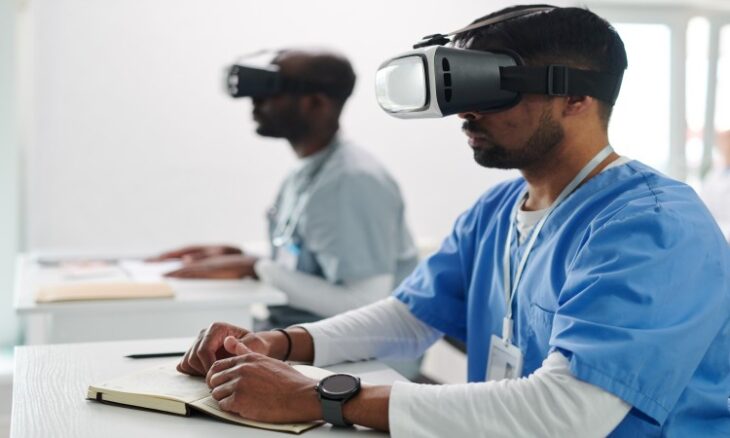
The study targeted 3D molecular structures, which are often difficult to visualise through standard diagrams or textbook images. Using the Nanome platform and VR headsets, students examined haemoglobin’s structure, functions, and conformational changes. This interactive method enabled unprecedented collaboration and exploration of molecular models.
During the study, students consistently provided positive feedback on the technology’s value for learning. The project embraces active learning and deliberate practice, now foundational in medical education. Beyond being published, the project also secured first place for its poster presentation at the recent Medical and Education Technology Conference (METC) 2025. The conference, hosted by WCM-Q in October last year, highlighted innovations in health education. Iman Dajani, a first-year medical student, was commended for demonstrating the project’s impact on learning.
Project leaders assert that both the publication and METC award underscore the university’s commitment to educational innovation. Virtual reality is now recognised as an integral part of student learning, not just a pilot tool. Following initial success, VR activities have been incorporated into several courses, reflecting the university’s shift toward participatory learning and sustained improvement. Ms Christina Esteban played a key role in initiating and scaling these efforts, ensuring the technology became embedded in daily instruction.
This ongoing initiative supports Weill Cornell Medicine-Qatar’s mission to unite advanced education with pioneering research and innovation. These efforts aim to improve healthcare in Qatar and the surrounding region. The school plans to extend VR-based instruction into more foundational science courses and to support faculty interested in adopting these immersive methods.
Dr Marco Ameduri, senior associate dean for pre-medical education, affirmed the college’s strong commitment to leveraging the latest technology for optimal student outcomes. This study demonstrates the school’s careful evaluation of innovations before integrating them into the curriculum. The validation of virtual reality as an effective teaching tool helps pre-medical students master challenging subjects. These advancements reinforce the school’s leadership in merging technology and medicine for the benefit of future physicians.